“On the Trail of Henry Knox” by Jennifer Dorsen (3 of 5)
3. In which I Visit Fort Ticonderoga and Dr Matt, Meet a pair of Oxen, and Search for Potential Hidden Clues.
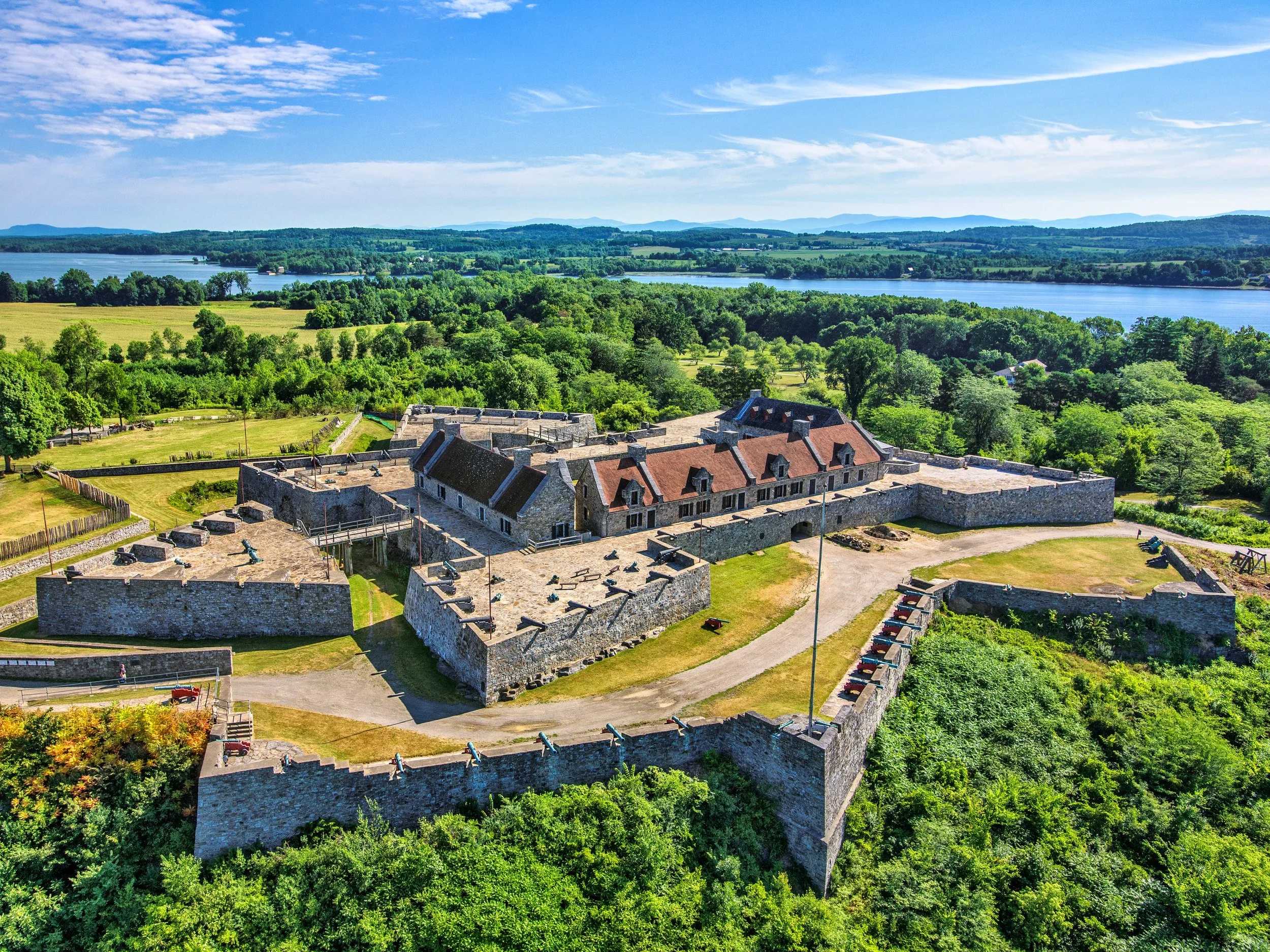
Fort Ticonderoga
My next stop was Fort Ticonderoga between a visit to a friend in Burlington, VT and a hike in the Adirondacks. I had become a minor expert on Knox and Somerville’s contributions to the Revolutionary War, but I had still not found Cobble Hill’s cannons. Perhaps clues could be found at the Fort.
It was another lovely summer day, and I drove along Lake Champlain, through the corn fields and overgrown farmsteads of upstate New York until arriving at the Fort at the end of the road. Who does not love a good fort! With terrific views of the river, dozens of rooms, a team of oxen demonstrating their strength by pulling logs back and forth, and interpreters helping visitors understand everything from firearms to colonial music, it makes a great visit!
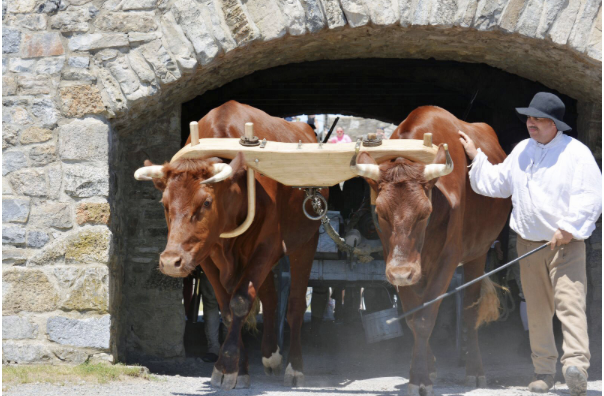
Oxen at Ticonderoga
A volunteer at the Somerville Museum happened to be an intern at Fort Ticonderoga over the summer and she connected me with Dr. Matt Keagle, curator, enthusiastic expert on just about everything, and one of those people who is everywhere. In fact, that includes last spring when he was one of the 70 “Redcoats” reenacting the midnight march to Lexington and Concord through Somerville! He graciously spent an hour talking about Knox and Somerville with us.
Sitting around an oak desk at the staff offices half a mile from the Fort itself, Dr Matt filled in some of the history, both well known and under on-going exploration. People lived at “Ticonderoga” for generations before the European settlers, and the word means “place between two great waters” in indigenous languages.(7) From the high bluffs, one can see a panorama of the wide river and the low fields across Lake Champlain in Vermont. The French built the fort, but it was captured by the British in 1759, and inside was a treasure trove of cannons and other armaments that had been crafted by French and others, used in the “French and Indian War” among other North American colonial efforts.
How did our man Knox get the cannons out of the Fort? And can we trace any of them to Somerville? To answer this, we have to jump back to Cambridge. General Washington took over the army in July 1775, and spent the next months trying to find ways to defeat the British, a job for which he needed soldiers (and the means to keep them alive) and armaments. Conveniently, Fort Ti (I was very quickly adopting the lingo of the Knox enthusiasts) - only lightly guarded - had been captured in a midnight raid a few months prior (May 10, 1775) by Ethan Allan and Benedict Arnold. The fort and the cannons were now in American hands.
With that in mind, Knox was tasked with getting them back to Boston. He left Cambridge on November 20th first to New York City to gather information and support, and then to Fort Ticonderoga. Arriving at Fort Ti in early December, he quickly gathered the items he wanted, prepared them for transport, and readied his men for the task ahead. Five days later they set out with 60 tons (120,000 pounds) of cannons, guns, lead shot and other related supplies. On current roads that is 705 miles, and Google tells me it would take 266 hours to walk it. I assume he had a horse.
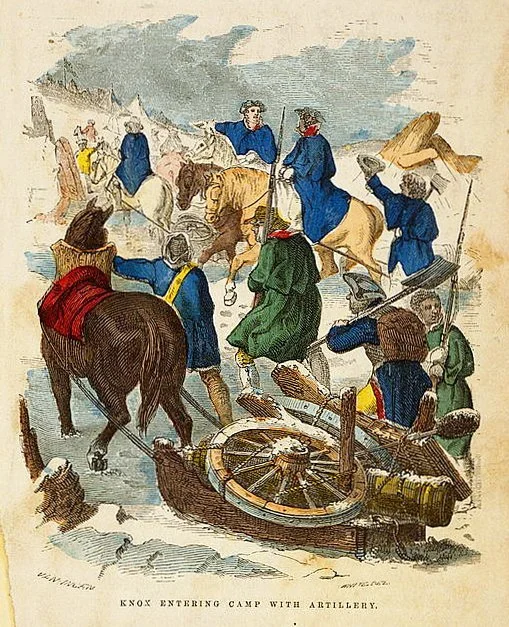
He called this effort the Noble Train of Artillery, and it must have been a sight! Let’s do the numbers: (8)
The “Train” consisted of fifty-nine brass and iron cannon, howitzers, mortars, and cohorns from their mounts and secured several tons of shot, 2300 pounds of bullet lead, and 30,000 gunflints.
They used "42 exceeding strong sleds" and 80 yoke of oxen, many horses, and many groups of locals to guide this expedition.
A total of half a mile of rope secured everything to sleds, and each sled had an ax so that if a sled fell through ice it could be cut quickly and save the horses and oxen from being dragged under.
Travel was 300 miles across the Hudson River (four times), the Berkshires, and the Connecticut River, among many smaller frozen and partially frozen rivers.
Number of cannons that fell through the ice: 2. Number recovered from the depths: 2.
Predicted travel time: under 20 days. Actual travel time: 56 days.
Budget from Washington for this work: 1000 Pounds.
After meeting with Dr Matt, I toured the fort, its many rooms and displays of historic artifacts. As I walked around, a trio of musicians were providing the soundtrack of colonial life. In one gallery, I had a conversation with an eighty-year-old volunteer docent who wore the various military honors of her extended family - from World War 2 soldiers to current national guard, among others. For her, this location was an important continuation of her family’s connection to the military. While Fort Ti has the largest collection of cannons in the Western Hemisphere, almost none of the original cannons that Knox touched survived due to either poor record keeping or reusing the metals for subsequent purposes.
On my way out of the Fort, I looked at an array of cannonballs of various sizes, and wondered about the people who risked their lives, prepared to take the lives of others, and disrupted the lives of their families and communities for the hope of something they could not define nor predict.
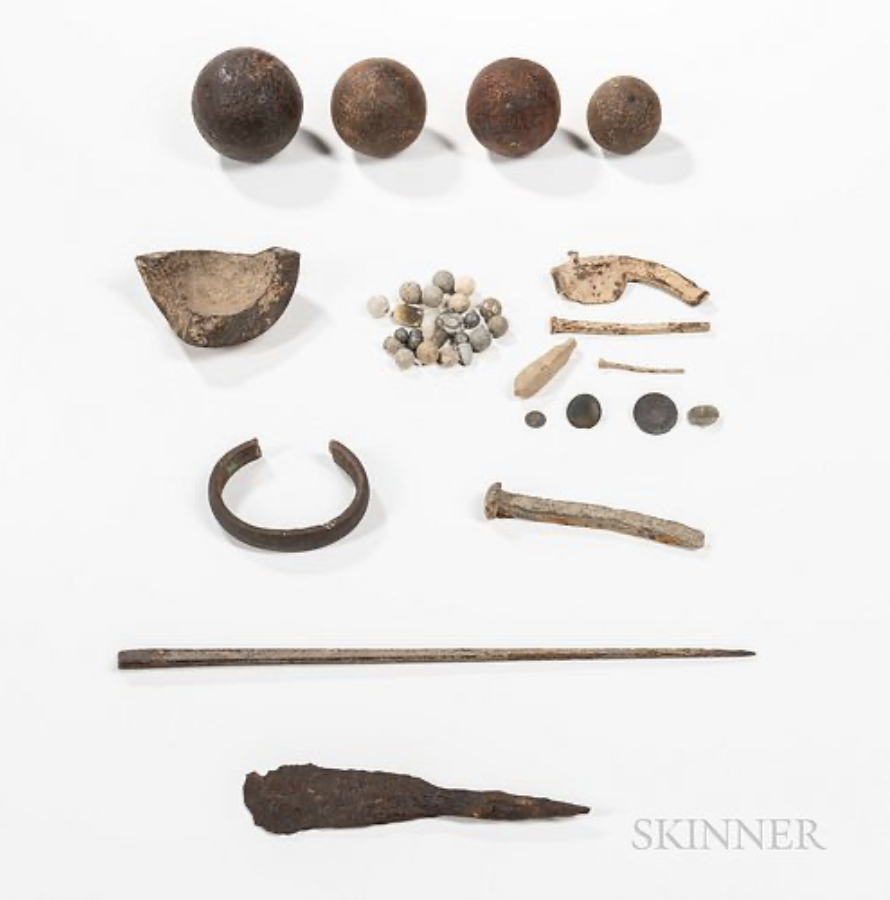
Relics from the Fort Ticonderoga Area for sale at auction.
As to getting clues about the Cobble Hill cannons, Dr Matt suggested a few next steps. Historians have limited types of resources: Letters, journals, maps, legal filings, and military records (like pension records and orderly books which record the daily activities in camp). Our modern world is flooded with instant documentation, so this lack of material is frustrating. Furthermore, while attempts were made to collect and preserve Revolutionary materials, not everything has survived over the years.
Letters and journals from the generals are digitized and often available online, so I added those of William Heath and Nathanael Greene to my to-read list. The orderly books would be another piece of research altogether! To find my needle in the Siege of Boston haystack would be a complicated task involving recreating lists of soldiers in each regiment and company, finding the orderly books associated with those groupings and searching through handwritten notes for daily tasks related to February-March 1776. One could even scour British reports of those days to see if they noticed our Cobble HIll. Initiating that level of research was clearly well beyond this project!