

“On the Trail of Henry Knox” by Jennifer Dorsen (5 of 5)
Heath Papers. Conclusion and Dead Ends.
In the Winter of 1775-76, the Siege itself was at a standstill. The British were surrounded by the colonists on all sides. About 4000 troops were living on Prospect Hill. The Colonists did not want to attack and be defeated again as they had at the Battle of Bunker Hill that past spring. So they each waited for the other to make the first move. “Our life in camp is confined. The officers are not allowed to visit Cambridge, without leave from the commanding officer, and we are kept pretty closely to our duty. The drum beats at daybreak, when all hands turn out to man the lines. Here we stay till sunrise, and then all are marched off to prayers. We exercise twice a day, and every fourth day take our turns on guard” (12). It had been a long, cold winter. A few of the important places closest to Boston had cannons ready to go including at Cobble Hill where an 18 pounder had been captured from the British and placed there.(13) In fact there might have been two cannons there, but it is a bit tricky to trace each armament.
On January 27, 1776, Henry Knox arrived in the area with the cannons, reporting at General Washington’s headquarters on Brattle Street in Cambridge. The war council planned their deployment. Historical documents show that there was disagreement about how to use the newly arrived cannons to best effect. Sadly, General Nathanael Greene, point person for Prospect Hill, stationed on Milk Row (now Somerville Avenue), was sick in bed with jaundice and out of commission for most of this time. Knox himself kept a journal of his efforts sporadically, including noting that Cobble Hill had more than one cannon on it in early March.
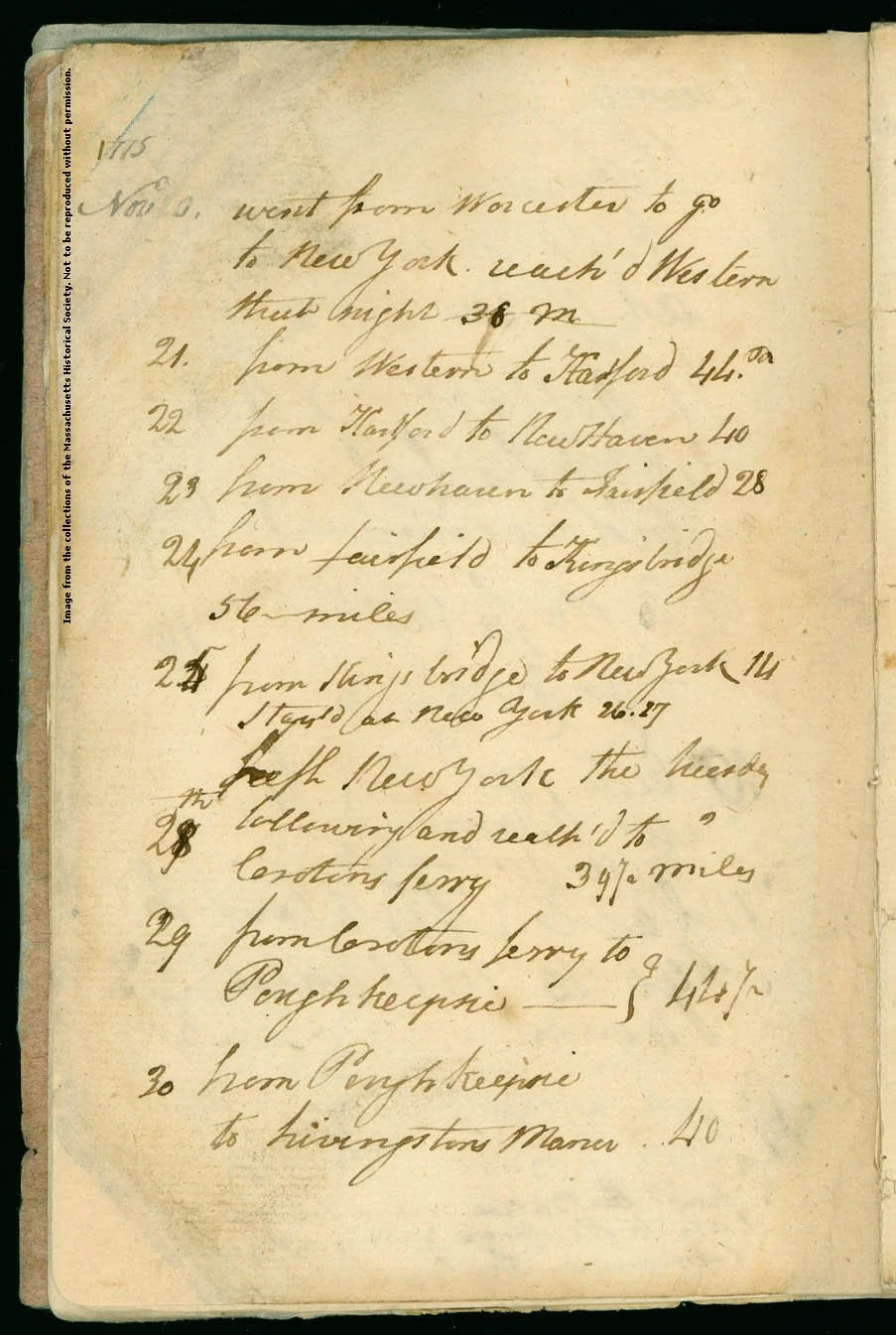
Henry Knox Diary [20 November 1775 - 13 January 1776], p. 8, Massachusetts Historical Society. https://www.masshist.org/database/viewer.php?item_id=463&mode=large&img_step=8#page8
Brigadier General William Heath kept a detailed journal and I was fortunate that Professor Dan Breen offered his Saturday to go to the Massachusetts Historical Society to see them in person. Of course, being 250 years old, these papers are sometimes smudged, and in a few places the handwriting is quite poor and there is some ambiguity about details. With his notes we can recreate the events of March. However, we know that, in the end, the American forces devised a two-phase plan. First, fire on the British from Cobble Hill, Lechmere Point and Lamb’s Dam, a dam across a narrow isthmus to reduce tidal flow, built by Joshua Lamb, near the corner of today’s Washington and Northampton Streets in the South End. Brigadier General William Heath writes about the night of March 3-5, “at Eleven at night a Cannonade and Bombardment on the Town of Boston, began from the Forts on Cobble Hill and Lechmeres Point, which was Seconded from the works at Lambs Dam in Roxbury, And Continued with Intervals Untill [sic] morning,”(14)
The effect was for the British to feel surrounded, surprised and shocked by the force of the armaments. Horatio Gates mentioned in his letters that the cannons fired for three days, creating a “Great Havock” (15)in Boston. Abigail Adams, living in Quincy, felt her house shake and was kept awake from the noise for three nights. She wrote to her husband John (spelling in the original), “I went to bed about 12 [at night] and rose again a little after one. I could no more sleep than if I had been in the ingagement. The ratling of the windows, the jar of the house and the continual roar of 24 pounders, the Bursting of shells give us such Ideas, and realize a scene to us of which we could scarcly form any conception. About Six this morning, there was quiet. . . .” Now quite certain that the Americans did not want them in Boston, the British started to pack their ships to leave with all their people, supplies and military gear. Abigail calls the nearly 100 ships a “forrest” of masts.
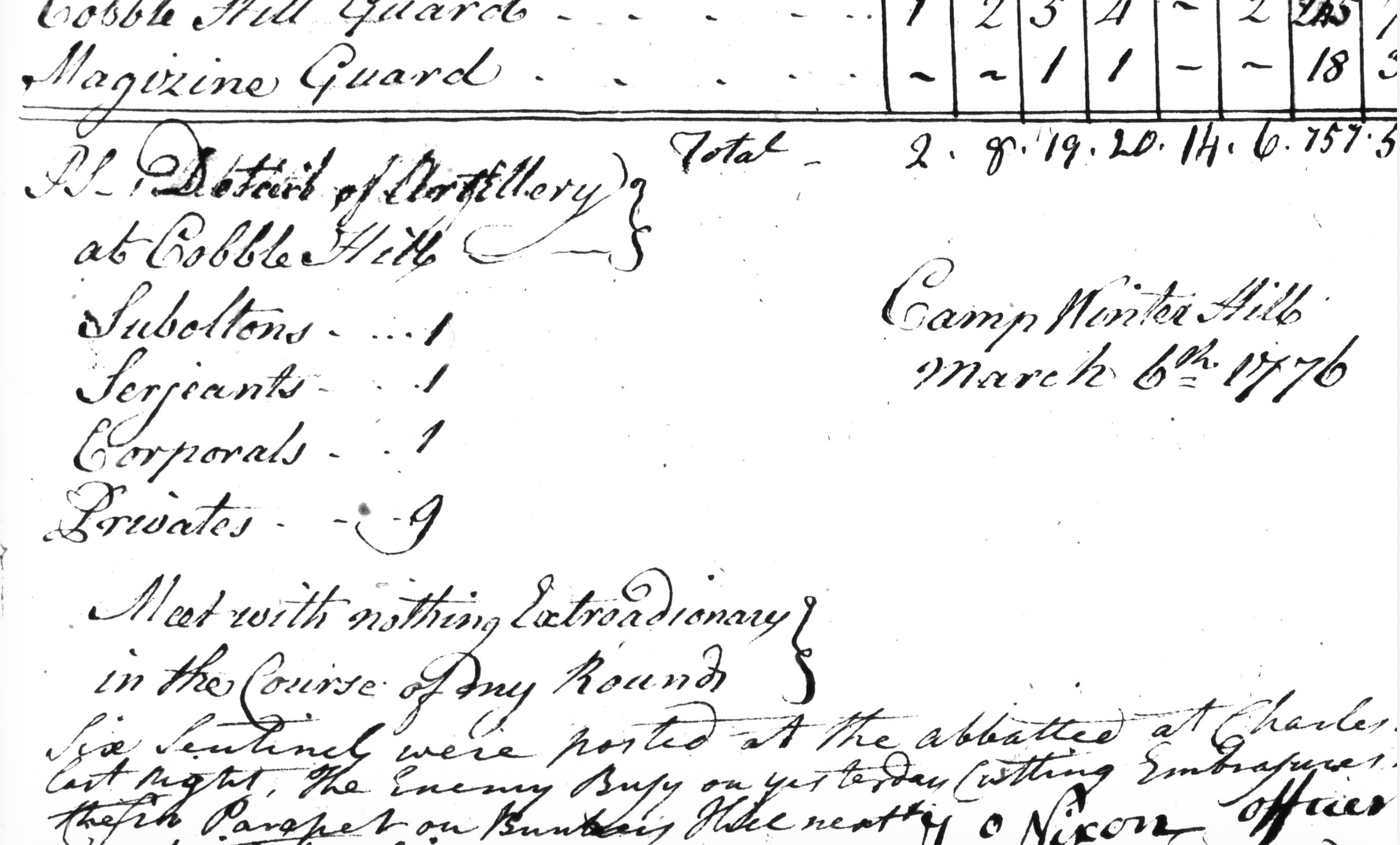
Brigadier, William Heath Diary, Massachusetts Historical Society. Photo by Dan Breen.
About this time, the second effort started: a secret, midnight plan to get most of the Knox Cannons into position on Dorchester Heights. After a number of days of prep work, and under a full moon, soldiers placed wooden and straw supports on the frozen ground, and slid the cannons up the hill, pointing at the British encampments on Boston Common. When the British awoke on the morning of March 17th, General Howe of the King’s army was shocked to find that “My God these fellows have done more work in one night than I could make my Army do in three months.”(16) He sent word that they were leaving and would not burn Boston as they left. They finished packing and sailed out of the harbor. The war never returned to Massachusetts.
In the following weeks the cannons themselves were moved south to New York for the next phases of the war efforts. Without the type of recordkeeping that we find basic now - photos, barcodes, QR codes, engraved numbers, etc - the cannons are hard to trace. After the war ended in 1789, they deployed to different places, and then when the Civil War started they moved again or were melted down for other purposes.
The best place to see cannons yourself is at Fort Ticonderoga, and replicas exist at various historic sites on the eastern seaboard. In our backyard, the Cambridge Common has a marker to Henry Knox’s efforts and replica cannons. A small fort in Cambridgeport was used as a training ground and a back-stop for potential Redcoats landing in Cambridge. They have collected some cannons and it is well preserved. (17)
For all this investigation, we have only speculation. The Heath Papers and other primary sources do not allow us to draw a firm conclusion. In the end, probably all we can say is that there may have been 18-pounders (or other armaments) from Ticonderoga at Cobble Hill, but we can't be sure. I would not be surprised if some were emplaced there in December and then others later on, courtesy of Knox. Surely it's still worth commemorating the fortification at Cobble Hill and the bombardment of Boston, even if the best we could do on a plaque is say there MAY have been Noble Train cannons there.
12. Lieutenant Shaw writes, (Feb. 14,) can’t find cite.
13. https://archive.org/details/historyofsiegeof02frot/page/296/mode/2up
14. https://founders.archives.gov/?q=%22cobble%20hill%22&s=1111311111&sa=&r=20&sr= (retrieved Nov 13, 2025)
15. https://founders.archives.gov/documents/Adams/06-04-02-0018
16. https://boston1775.blogspot.com/2023/03/i-hear-that-general-how-said.html
17. https://historycambridge.org/history-hubs/fort-washington-history-hub/