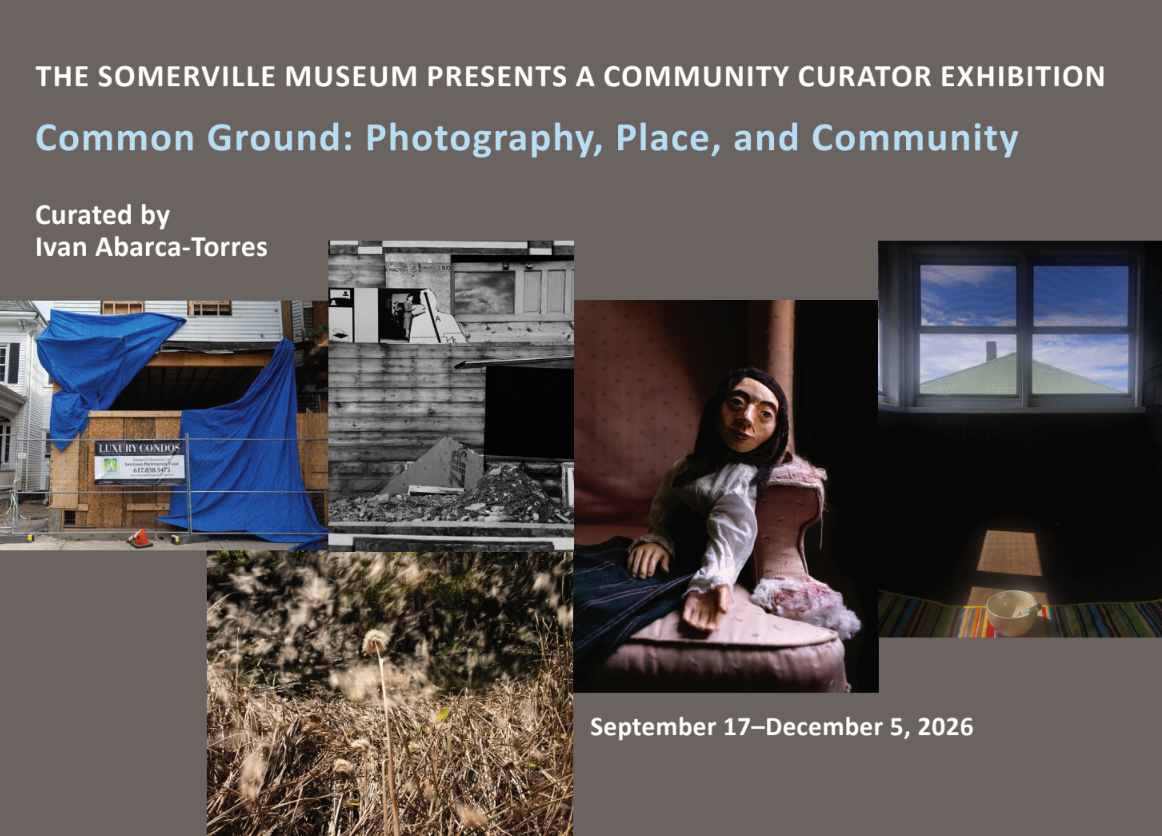
Common Ground: Photography, Place, and Community
September 17th - December 5th
This exhibition features 15 photographers who have chosen Somerville as their home. The works on view range from documentary to conceptual and are united by the perspective of artists living and working within this evolving urban environment. “Common Ground” explores how artists navigate and contribute to Somerville’s shifting identity, examining the relationship between place, community, and creative practice. Photographers such as Hannah Altman, Tynan Byrne, and Iaritza Menjivar explore layered identities and notions of community while Greer Muldowney, Yorgos Efthymiadis, Amber Tourlentes, and Charan Devereaux examine the urban landscape, unionized workers, and gentrification in Somerville. Brian Truglio, Henry Cataldo, Mary Kocol, and Ken Richardson also document specific moments in time in their chosen city and beyond. Sharon Harper, Dana Mueller Robinson, Stephen Tourlentes, and Lucie March interrogate our relationships to the built and natural environments.
Together, these works reveal how vibrant and creative Somerville’s photographers are while reminding us how a photograph can be an object for contemplation, bear witness, serve as social, political, and environmental commentary, as well as bring forth untold stories of diverse identities.
Reviews
https://www.thesomervilletimes.com/archives/151365#more-151365
https://www.whatwillyouremember.com/common-ground-photography-place-and-community-group-show-at-somerville-museum-in-ma/
Programming
Opening reception, September 17th, 6pm - 8pm. For tickets click here.
We are grateful to Lalo Development LLC Gorka and Laurentzi Brabo for their sponsorship of the opening reception.
Documenting Somerville: Labor, Community, Housing
Thursday, October 22, 7pm
Join a discussion with curator Ivan Abarca-Torres and photographers Charan Deveraux, Yorgos Efthymiadis, Greer Muldowney, Amber Tourlentes, Steve Tourlentes, and housing specialist, William Camilo Shelton. The group will discuss their individual approaches to documenting the evolving urban landscape in Somerville.
Panel Discussion on Photographic Practices from Common Ground
Thursday, November 5, 7pm
Join Kristen Gresh, Estrellita and Yousuf Karsh Senior Curator of Photographs, MFA Boston, for a panel discussion with Hannah Altman, Tynan Byrne, Lucie March, and Dana Mueller Robinson about the range of their creative practices in "Common Ground: Photography, Place, and Community."
Saturday, October 31, 11am
Curator Tour
Saturday, December 5, 11am
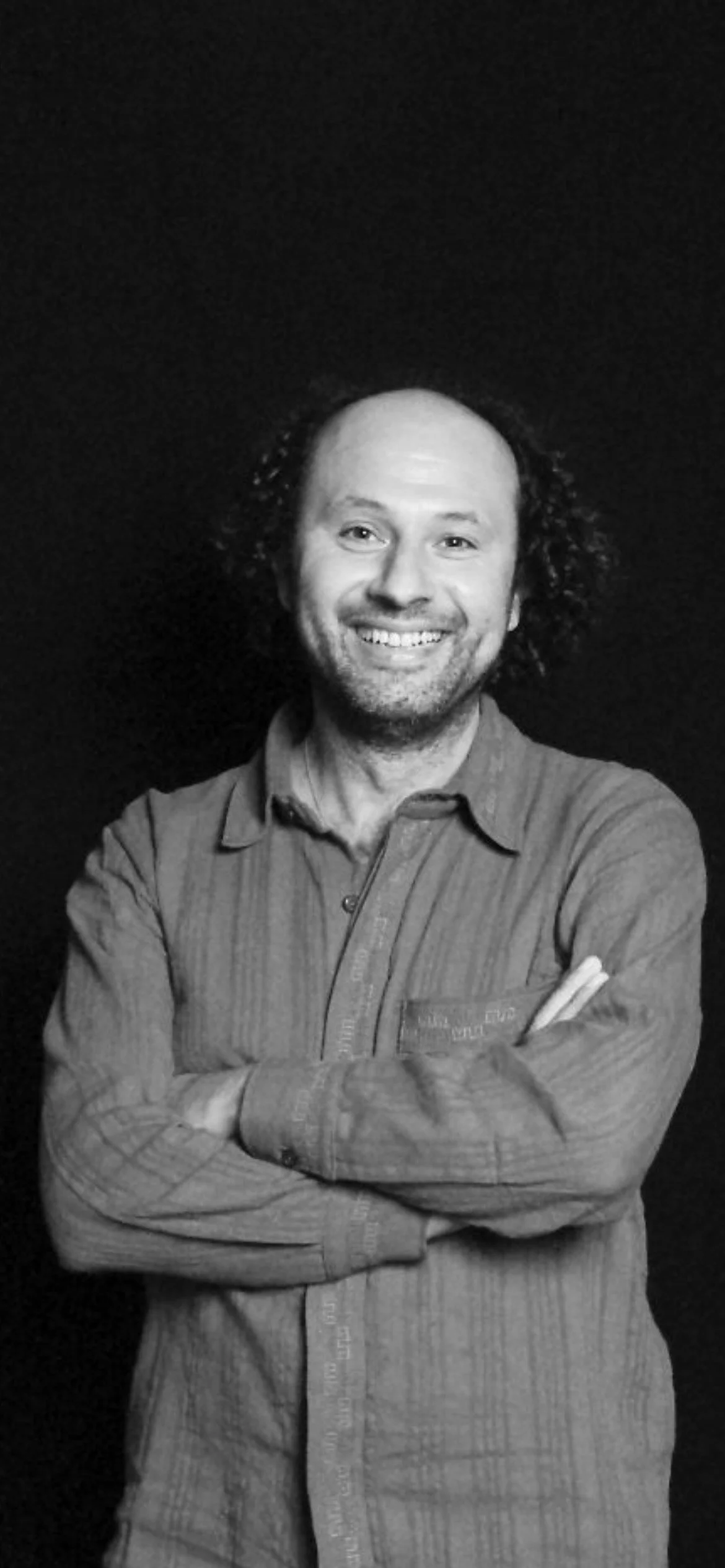
Ivan Abarca-Torres, Curator
Ivan Abarca-Torres, PhD, is a Somerville resident, researcher, educator, and former diplomat, as well as a community organizer with Padres Latinos of Somerville Public Schools and a board member of local cultural and community organizations. He was also the co-curator of “Museo Inmigrante” at the Somerville Museum and a recipient of the Latino Excellence Award from the Black and Latino Caucus, Massachusetts State House in 2024.
ARTIST BIOS:
Sharon Harper
Sharon Harper works at the intersection of technology, perception, and the living
environment. Her work is in permanent collections at the Museum of Modern Art, New
York, the Whitney Museum of American Art, New York, The Metropolitan Museum of
Art, New York, The Museum of Fine Arts, Houston, The Albright-Knox Art Gallery in
Buffalo, the Harvard Art Museums, the Santa Barbara Museum of Art in Santa Barbara,
California, the Nelson-Atkins Museum in Kansas City, Missouri, The New York Public
Library, and the Denver Art Museum among other collections. She is the recipient of a
Guggenheim Fellowship in Photography, a Meredith S. Moody Residency Fellowship,
and an Elizabeth Ames Residency Fellowship at Yaddo, a Sam and Dusty Boynton
Residency Fellowship at the Vermont Studio Center, and residency fellowships at the
Headlands Center for the Arts in Sausalito, California, the MacDowell Colony, the
Ucross Foundation, the Virginia Center for the Creative Arts, the Monastery of Halsnøy,
Norway, the Bernheim Arboretum and Research Forest in Kentucky, and the Marble
House Project in Dorset, Vermont. A monograph of her work, From Above and Below,
was published by Radius Books. She is the Emmet Blakeney Gleason Professor of Visual
Art, Department of Art, Film, and Visual Studies, Harvard University.
Amber Tourlentes
Amber Tourlentes’ solo and group exhibitions include the Museum of Fine Arts,
Boston, the MassArt Art Museum, Smith College, Lesley University, Amherst College,
APE Gallery, the Boston Public Library, and many more. She is also a recipient of the
Massachusetts Cultural Council Faculty Fellowship Grant. Amber earned her MFA and
her BFA from the University of Massachusetts, Amherst, in Photography and Art History.
She has also led interdisciplinary panels focused on the LGBTQ+ Family Movement
at the Kahn Institute, Smith College, Emerson College, the Museum of Fine Arts in
Boston, and the Family Equality Council at Disney World, Florida. Amber has been
involved with several activist and legal coalitions serving queer communities, including
GLAD (Gay & Lesbian Advocates and Defenders), the Human Rights Campaign
(HRC), Family Pride, and COLAGE (Children of Lesbians and Gays Everywhere). Her
photography has been featured in numerous fundraiser exhibitions, targeting various
LGBTQ+ publications, as well as in major media outlets like Newsweek, CNN, Fox
News, and academic journals. Amber’s photographic archive presents a case study on
the economic mobility and continuous redefinition of political class territories.
Amber’s most recent projects examine the history of paper currency and the use of
precious metals, investigating how these elements helped develop photographic
printing processes and how photography functions within a capitalistic system.
Her larger body of work and research explores the possibilities for contemporary
American families to construct gender, sexual, racial, and class identities within the
normative nuclear family culture and institution and revisits the contested traditions of
photographic practices for both public and private archives.
Hannah Altman
Hannah Altman is a Jewish-American photographer whose work considers myth,
performance, memory, and lineage. She holds an MFA from Virginia Commonwealth
University and is based in Boston, MA. Her photographs and books Kavana (Kris Graves
Projects, 2020) and We Will Return to You (Saint Lucy Books, 2025) are held in libraries
and collections including the Museum of Modern Art, Metropolitan Museum of Art,
Getty Center, Block Museum, Cleveland Museum of Art, Harvard University, Princeton
University, Stanford University, and the Yale Slifka Center, where she was the 2022-2023
Blanksteen Artist in Residence.
Altman’s work has been exhibited worldwide at institutions including the Jewish
Museum (NYC), Virginia Museum of Contemporary Art, MK&G Hamburg, Houston
Center for Photography, Koffler Arts (Toronto), Candela Photographic Arts (Richmond),
Ogden Museum of Southern Art, and Silver Eye Center for Photography (Pittsburgh).
Her photographs have been published in The New York Times, Artforum, Vanity Fair,
Harper’s Magazine, LensCulture, and British Journal of Photography, among others.
She was a finalist for the 2022 Hopper Prize and 2023 Aperture Portfolio Prize, received
the 2022 Portraits Hellerau Photography Award First Prize and a 2023 Innovate Grant,
was a 2025 Arnold Newman Prize honorable mention, and was nominated for the 2025
Cultured Magazine Young Photographers List.
Yorgos Efthymiadis
Yorgos Efthymiadis is a Greek-born visual artist and independent curator based
in Somerville, MA. He is a 2025 Foster Prize Winner (Institute of Contemporary
Art/Boston) and a recipient of Collective Futures Fund 2025 Grant (The Warhol
Foundation). Efthymiadis is a Massachusetts Cultural Council Fellow (2025, 2017), and a
St. Botolph Club Foundation Fellow (2017).
Mary Kocol
Mary Kocol is a fine art photographer based in Somerville, Massachusetts. Her earlier
urban twilight photographs are among the permanent collections of the Museum of
Modern Art, J. Paul Getty Museum, Museum of Fine Arts Boston, Victoria and Albert
Museum in London, and others. She’s a recipient of the Guggenheim Fellowship and
several Massachusetts Local Cultural Council grants. In 2024, she received an LLC
Visual Art Fellowship Grant from the Somerville Arts Council.
Born in Hartford, Connecticut, Mary was educated at the University of Connecticut and
the Rhode Island School of Design, where she earned a Master of Fine Art degree in
Photography. She’s also a Massachusetts master gardener.
Her photographs are represented by Gallery NAGA in Boston.
Greer Muldowney
Greer Muldowney is an artist, photography professor, and independent curator
based in Somerville, Massachusetts. Her work often tackles the relationship of policy
making and how it affects landscape, housing, and community. She received an
undergraduate degree in Political Science concentrating in Urban Policy and Studio
Art from Clark University, and an MFA from the Savannah College of Art and Design.
She has acted as the Curator for the Desotorow Gallery in Savannah, GA, and was
the Regional Coordinator for the Flash Forward Festival on behalf of the Magenta
Foundation in Boston, MA. She has served on the Board of Directors for the Midway
Artist Studios and the Griffin Museum of Photography and is the Founder and Director
of Undergraduate Photography Now, an arts organization bolstering the work and
professional development of photography students. She has juried and curated
exhibitions nationally and is currently an Associate Professor at Boston College.
Lucie March
Lucie March is an artist working with the still and moving image. Lucie’s work has
been exhibited in New York, Los Angeles, Boston, and Rome, published by MATTE
Magazine, Saint Agnes Studio, and others, and is held in the collections of the
Somerville Public Library and the Museum of Modern Art Library. Lucie holds an MFA
in Photography from the Massachusetts College of Art & Design and is affiliated faculty
at Emerson College. Lucie co-creates the zine cul de sac with Marie Igea and co-directs
Front Room, an experimental gallery space in Somerville, MA, with Lena Warnke.
Henry Cataldo
Henry Cataldo is an artist and photographer whose work explores light, form, and the
quiet poetry of the visual world. A longtime resident of Somerville, Massachusetts, he
focuses on place, history, landscape, and the evolving character of communities. As a
retired educator, he brings the discipline and curiosity of the classroom to his creative
practice, approaching photography as fine art with careful attention to composition,
tone, and craft. Deeply connected to Somerville, Cataldo has documented the
city’s streets, architecture, and neighborhoods, often using photography to create a
dialogue between the past and present. Particularly to his Somerville connection, he’s
participated in many group grants including Made in Somerville, Lost Theaters Project,
and A Portrait of an American City Through Its Gardeners.
In his most recent photographs, he’s tried to limit his camera’s frame to only the
canvases provided by a car’s windshield and hood area. His intent was to focus upon
the very temporary state that the light, weather, leaves, and reflections might provide.
His work has been exhibited at institutions including Tufts University, MIT, the University
of Michigan, and Galeria Mesa. He holds an MFA in Photography from Yale University,
as well as degrees from Stonehill College and Massachusetts College of Art and
Design. He taught photography for more than 40 years at several institutions including
College of the Holy Cross, Boston University, Massachusetts College of Art and Design,
and Concord-Carlisle High School.
Brian Truglio
Brian Truglio is a filmmaker, photographer, and professional editor. He is a 1998
graduate of the Visual Studies Workshop where he studied photography, sequencing,
and bookmaking with Nathan and Joan Lyons. His work has been exhibited at Bucknell
University, Gettysburg College, the Pyramid Arts Center, Ithaca College, and Texas
State University, among other galleries. He lived and worked in Ireland for five years
before moving to Somerville in 2007, where he now lives.
Brian has made two documentaries, Racing the Rez (2012) and Running Home
(2024). As a film and television editor, he’s worked on over two dozen PBS programs
for American Experience, Nova, and Frontline, including the Emmy winning Nova:
Manhunt: Boston Bombers (2013), the Emmy-nominated Frontline: Documenting
Police Use of Force (2024), and the independent PBS series Resolve to Solve with Miles
O’Brien (2026).
Tynan Byrne
Tynan Byrne is a visual artist living in Somerville, Massachusetts. His practice
predominantly incorporates photography into book arts, collages, and 3D work that
push the confines of the traditionally rendered photograph. Much of his work centers
around themes of romance and affection between men, prominently featuring those of
him and his partner as they navigate their life together. Byrne’s output is also impacted
by a studied appreciation for queer history and literature; he often adds elements of
magical realism to his black and white, color, and Polaroid-based imagery. He holds an
MFA in Visual Arts from Lesley University College of Art and Design, and has exhibited
at Golden Thread Gallery (Belfast, Ireland), Gallery Kayafas (Boston, MA), Anderson-
Yezerski Gallery (Boston, MA), Gravedigger’s Daughter (Waldoboro, ME), ViewPoint
Gallery (Nova Scotia, CAN), Tammy Cromer Gallery (Dallas, TX), and a number of
other galleries, pop-ups, and online exhibitions over the past decade. He is the
recipient of the 2026 Adjective Production Prize and currently works at the University of
Massachusetts Boston as the Instructional Media Technologist in the Art Department.
Ken Richardson
Ken Richardson is a Somerville, Massachusetts-based photographer with a focus on
portraiture, science, and wheels for commercial clients. He has photographed for
many editorial clients such as Technology Review, Time, The Wall Street Journal, Road
and Track, The New York Times, Bicycling Magazine, Science Magazine, and Boston
Magazine to name a few. He has lived in the Boston area most of his life, other than a brief
stint on the West Coast. When he’s not working for clients or shooting personal work, he is
either riding a bicycle, thinking about Vermont or hanging out with a little brown dog named Andie.
Sometimes doing all these things at the same time. He lives in the Union Square
neighborhood of Somerville, MA, with two amazing women, his wife and daughter.
Dana Mueller Robinson
Dana Mueller Robinson was born and raised in Thuringia, East Germany, before the
fall of the Berlin Wall. Working primarily in photography, her practice engages the
complex nature of the image as representation, interpretation, and speculation, with
research focused on social identities shaped by political upheaval, economic realities,
and shifting perceptions of belonging. Her work has been exhibited in solo and group
exhibitions at Rick Wester Fine Art (NY), the Bakalar Gallery, Massachusetts College
of Art and Design, the Houston Center for Photography (TX), and the Danforth Art
Museum (MA), among others. Publications include her first monograph, May Days
(Fraction Editions, 2018), artistic contributions to the issue of Der Greif: Tomorrow Is
Today (2025), and Keeper of the Hearth: Picturing Roland Barthes’ Unseen Photograph
(Schilt Publishing, 2020). Her forthcoming book, Edge of the Village / Grenzland will
be published by Hartmann Books this fall. She is Associate Teaching Professor in
Media Arts at Northeastern University and holds an M.F.A. in photography from the
Massachusetts College of Art and Design.
Steve Tourlentes
Stephen Tourlentes is a Boston based artist. His photographic practice investigates
the American landscape in the age of mass incarceration. His work is motivated by
his concern with the lack of social investment in communities that has contributed to
the systematic growth in the prison industry. His work has been widely exhibited both
nationally and internationally, including the Metropolitan Museum of Art, the Chicago
Art Institute, the Aperture Foundation, the Institute of Contemporary Art Boston, and
the Museum of Fine Arts Boston. He is the recipient of many awards for his work,
including a John Simon Guggenheim Foundation Fellowship, an Artadia Fellowship,
Massachusetts Cultural Council Fellowships, and is a McDowell Colony Fellow. He was
a finalist for the ICA Boston’s Foster Prize and is included in the upcoming DeCordova
Museum Biennial. He teaches and works in the Photography Department at the
Massachusetts College of Art & Design.
Iaritza Menjivar
Iaritza Menjivar is a Salvadoran Guatemalan American photographer whose work
explores memory, belonging, identity, and the complexities of home. Rooted in her
family’s immigrant experience and her own experience as a first-generation American,
she considers how history, place, and relationships shape what we remember and what
we carry. Moving between documentary and intuitive approaches, her work lingers in
the space between what is seen and what is felt. Menjivar is the recipient of numerous
grants and awards and has exhibited nationally and internationally. She holds a BFA in
Photography from Lesley University.
Charan Devereaux
Charan Devereaux collaborates with community members and organizations to tell
local stories. Her projects combine photography, oral history, archival research, music,
and live events to explore themes of work, faith, and home. Her work has been
supported by the Boston Foundation, Mass Humanities, and the Massachusetts Cultural
Council and received awards from the American Association for State and Local
History, the Massachusetts History Alliance, and the Massachusetts Commission on
the Status of Women. She has presented at conferences and nonprofit organizations.
Her photographs have been published in The Boston Globe and exhibited at local
galleries, museums, universities, and public spaces, including the Massachusetts State
House, Boston City Hall, and the Somerville Museum.
Yorgos Efthymiadis
Zahra and Marta’s stories from:
From The First Ones In Line series, 2024 - ongoing
Marta (right), 2025
Zahra (left), 2025
Pigments Prints
Zahra has worked for 20 years in the dining halls at Tufts University, where she led her. coworkers in a historic vote in 2018 to form the union and win a first contract. She then went on to organize hotel workers on their citywide strike in 2024.
“When we first started unionizing, I had just given birth to my daughter. I was a new
mother. I got involved in the fight because I knew we deserved more affordable health insurance. It would have been so hard for me to save for my daughter’s future with how expensive our insurance was. It wasn’t easy for my husband to understand why I had to spend so much time outside the house, meeting and organizing with coworkers, dragging along my child to meetings. But I knew I had to stand for what I believed, and I had to put in the work for it. We won that fight with our contract. Today I’m a union leader. I am a proud mom of two children. I am a resilient Somali woman. I am a widow.
What I fought for myself, I’m now teaching people to do it for themselves.”
Marta worked for 4 years at the Hyatt Regency until 2009, when she and 100 of hercoworkers were fired and replaced by outsourced cleaners making half their pay. The “Hyatt 100” fought for four years until they finally won justice and a fair severance. Marta went on to work as a housekeeper at the Parker House and the Omni Seaport, where in 2024 she led contract negotiations and also two strikes at her hotel.
“At first I was not very active in the union. But I started feeling like the bosses were abusing people, so little by little I got more involved to help my coworkers. When I first became a shop steward, it would almost cause me panic having to have a conversation with the boss in English. But now I don’t have that panic anymore. I go with my coworkers, I represent them because they need help, and it feels super. In 2018, my hotel didn’t go out on strike, but I would go after work to walk the picket line for other hotels that were on strike. Last year, I saw for myself just how different it is to be on strike yourself, to be outside for 8 hours, 10 hours straight, to have your job on the line.
It was a tough time, but we won. This was the difference we made ourselves. We lived the struggle in our own flesh, and we won.”
Stories from Union Square at Work
Charan Devereaux
Silvana Brizuela
The Tango Society of Boston
16 Bow Street, Somerville, Massachusetts
2015, from the series Union Square at Work: Photographs, stories and music from Somerville’s oldest commercial district
Silvana Brizuela has taught at the Tango Society of Boston in Somerville nearly every week since 2012. Brizuela lives in Queens, New York and takes a four-hour bus ride to Boston to teach lessons to groups and private clients in Union Square. Originally from Argentina, Brizuela trained as a ballet dancer at the Teatro Colón opera house in Buenos Aires, where she performed in many productions, and studied choreography and contemporary dance at the Teatro General San Martín. She began dancing tango late in her training, but found herself doing it more and more.
“Before I started learning tango, I used to dance alone,” Brizuela says. “Sometimes you have a partner in ballet or other types of dance, and you know the choreography, you know the count, but it is not the same [as dancing together]. In tango, there is no count, there is nothing, there is just the feeling between you and your partner, and the connection of the embrace. You learn what he wants to tell you through that connection. You have to be in the moment because you don’t know what will be. You let it happen. As a follower, you feel where the leader wants to take you—every step. And the leader has to feel your response, so you compose the dance together. Tango made me a better dancer in every way, I believe. It made me more perceptive, and more relaxed about the movement and the expression. You disappear into the dance.”
In addition to regular lessons, Brizuela participates in two annual Boston Tango Society events: the Boston Tango Festival in June, and the Celebrando Tango Musica y Cultura in October. “The October event celebrates Argentine culture—tango, but also folklore dance,” Brizuela says. “Tango is the city, but in the countryside, we have another 300 dances. I teach the most famous, the Chacarera, very playful, very joyful, a happy dance. We also celebrate the traditional Argentine yerba mate drink and Malbec wine—my dance partner is also a sommelier.”
Brizuela first met Tango Society of Boston president and owner Vicky Magaletta in New York, and Magaletta invited her to teach. Magaletta has operated the Tango Society for nearly 30 years. “Vicky is such a lovely character with charisma, a profound knowledge of our culture, and a deep commitment to promoting Argentine Tango artists. She makes me feel at home,” Brizuela says. “My heart and my headquarters are Vicky and the Tango Society of Boston.”
[For tickets to the Celebrando Tango Musica y Cultura, October 16-18, 2026, visit The Boston Tango Society website.]
Nissenbaum’s Used Auto Parts
480 Columbia Street, Somerville, Massachusetts
2015, from the series Union Square at Work: Photographs, stories and music from Somerville’s oldest commercial district
Owned and operated by the same family for five generations, Nissenbaum’s Used Auto Parts was one of the oldest salvage yards in the United States. The company was started in 1910 by Jacob Nissenbaum, an immigrant from Belarus. “My great-grandfather would go around with a team of horses and a wagon and pick up bones from the meat packing plants and sell them to the soap factory,” said Joe Nissenbaum, interviewed in 2015. “He also picked up scrap iron and rags. The doors where Jacob backed in his horse team are still part of our building, and we also own the old soap factory building.”
Nissenbaum’s grandfather focused on newspaper recycling, but passed away at a young age in 1937 after eight years with the company. Nissenbaum’s father, Max, took over the business and started recycling automobiles in 1955, later erecting the first state-approved auto body incinerator. “My father was raised in Somerville and lived to age 95. He knew half of Somerville –and they knew him,” Nissenbaum says. “I joined the business about 50 years ago with my brother Allen and we expanded into used auto parts sales.” Joe and Allen Nissenbaum also did business with their friends Tom and Ray Magliozzi, and were guests on the Magliozzi’s radio show “Car Talk” when it was a local program on Boston’s WBUR.
Nissenbaum’s recycled about 700 cars a year, including all remaining fluids, gasoline, and oil. The company’s two garage spaces were heated with waste engine oil; window washer fluid and antifreeze were drained, repackaged, and sold for a dollar a jug. Joe’s son Neil inventoried and tracked all the parts.
“If you come back in five or ten years, we won’t be here,” Nissenbaum said. “Everything will be changed, but I think it will change for the better. I’m interested in the way communities develop and how people are what they are. And I’m interested in the legacy for this land.”
Nissenbaum’s Used Auto Parts closed permanently on December 1st, 2022.
Francis Fahey [March 1, 1950 - April 16, 2024]
A-1 New & Used Plumbing and Heating
30 Prospect Street, Somerville, Massachusetts
2014, from the series Union Square at Work: Photographs, stories and music from Somerville’s oldest commercial district
Fran Fahey was a collector. “I was born and raised next to a scrapyard,” Fahey said in a 2014 interview. “You become a product of your environment.” Some might remember Fahey’s expansive collection of vintage radiators outside his house on Prospect Street in Union Square, the current location of 10 Prospect, a lab and office space building.
Fahey’s company, A-1 New & Used Plumbing and Heating sold antique plumbing fixtures on Prospect Street for over 30 years and Fahey appeared on the PBS home renovation show This Old House. After his property was purchased under eminent domain, Fahey moved his radiators from Union Square into a storage facility in Everett.
Fahey’s family lived and worked on Prospect Street for three generations. His grandfather bought the property in 1910 after moving to Somerville from Genoa, Italy. Fahey was raised in the house. “In the 1950s, when I was a kid, Prospect Street was still a cobblestone road,” he said. “There were cars of course, but there were still horse-drawn wagons. There was a one-team horse junk man. You could hear him coming from far away, clippety-clop, clippety-clop on the cobblestones. It was almost like a musical instrument. He would yell out, ‘Rags, copper, paper, brass!’ and he had a scale in the back. You would bring out your things and he would weigh them and pay you. The rags were worth more if you took off the buttons and zippers.”
Growing up as one of nine children, Fahey worked a variety of jobs in Union Square. When the New England Dressed Meat & Wool slaughterhouse was torn down, Fahey was hired to “pinch” cobblestones out of the ground and throw them onto a truck. “I was 13,” Fahey said. “It was hard work, but $1 an hour was a lot of money in 1963.” Fahey also painted trailers at Schertzer Lo-Bed Trailers and ran a bag press at Consolidated Bag & Foil.
Soon after, Fahey began working as a plumber, installing his first bathroom at age 20. He would bring back copper, lead and metal scrap from his plumbing jobs and sell it at Prospect Iron & Steel, the scrapyard next door. “I had learned early the ins and outs of a scrap yard and how it worked,” Fahey said. “I was always an enterprising guy.” Fahey also sold used radiators and clawfoot bathtubs to a plumbing supplier on Mystic Avenue. “But one day, the guy said, ‘I can’t buy them, I’m leaving,’ So I got the idea I would try to sell them myself,” Fahey said. He asked the supplier how to price a radiator, and was told $75. “That was a good price in the early 80’s,” Fahey said. “That price rang a bell—I could see there was a market. So I started selling radiators on Prospect Street.” Later, Fahey added sinks and tubs to his business.
Fahey reflected on how the city of Somerville has changed. “Now, they rip a house down to the studs and put in the Tyvek and the HVAC and decide to trim the front in copper,” said Fahey. “They invest that kind of money because they think they’ll get it back, and they probably will. But back then, we were slobs, we didn’t have much. This was a working-class town. There was manufacturing and production and foundries. People struggled to get a tenant, people struggled to pay rent, people struggled to repair their houses. We did things on nickels and dimes and shoestrings. It was a different time.”
Fran Fahey passed away in April 2024, and a memorial service was held at St. Joseph’s Church in Union Square. Selected by Fahey’s grandson, filmmaker Marcus Fahey, this photograph was the only image displayed at the service.
Reliable Market
45 Union Square, Somerville, Massachusetts
2015, from the series Union Square at Work: Photographs, stories and music from Somerville’s oldest commercial district
Reliable Market has been in business for more than 45 years. Pokye Casserly, her brother Onguye Cho and her two sisters purchased the market in 2012. “My brother and I still work here seven days a week,” Casserly says. “Even if they say they don’t need me, I get more done during the day if I come here.” Casserly likes working for herself, and owned her own business at Logan Airport for 21 years before taking a chance on the Union Square store. Growing up, her family owned a small market in South Korea.
Reliable Market specializes in sake, sushi-grade fish, hard-to-find beer, groceries, Korean soju, and homemade kimchi, a fermented vegetable dish made by Cho. “My brother gets up at 1:00 am every Wednesday morning and drives to New York to buy napa cabbage for his kimchi. He can only find the kind he likes in New York,” Casserly says. “He has gone every week since we owned the store. My sisters and I tease him that he must have a girlfriend there, but he says he has no time!”
Casserly says Reliable Market’s neat shelves are stocked by employees Santo and Raul, who began working at the store for its previous owner in 2003 and 2005. “Santo is unbelievably organized,” Casserly says. “He always tells me, ‘I don’t want to do anything later, I want to do it now.’” Reliable Market receives regular deliveries of Korean and Japanese food items from New York, New Jersey, and Chicago. “Business is harder right now,” Casserly says. “When we started, many of our products were only carried by Asian markets. But now, larger stores with more buying power carry some of the same products.”
In January 2026, Casserly, her son Paul and daughter-in-law Yajaira opened K-bok Korean Fried Chicken restaurant just around the corner, specializing in crispy Korean wings, entertainment, and cocktails. One of the restaurant’s signature chicken sandwiches features pickled radishes and Onguye Cho’s kimchi. Casserly shares a video of people dancing at the restaurant in the evening. “Stop by and visit us,” she says.