6 -UNION SQUARE / “Liberty Pole Square”
Listen!
Leddy Rosalia Saenz
Artist Statement
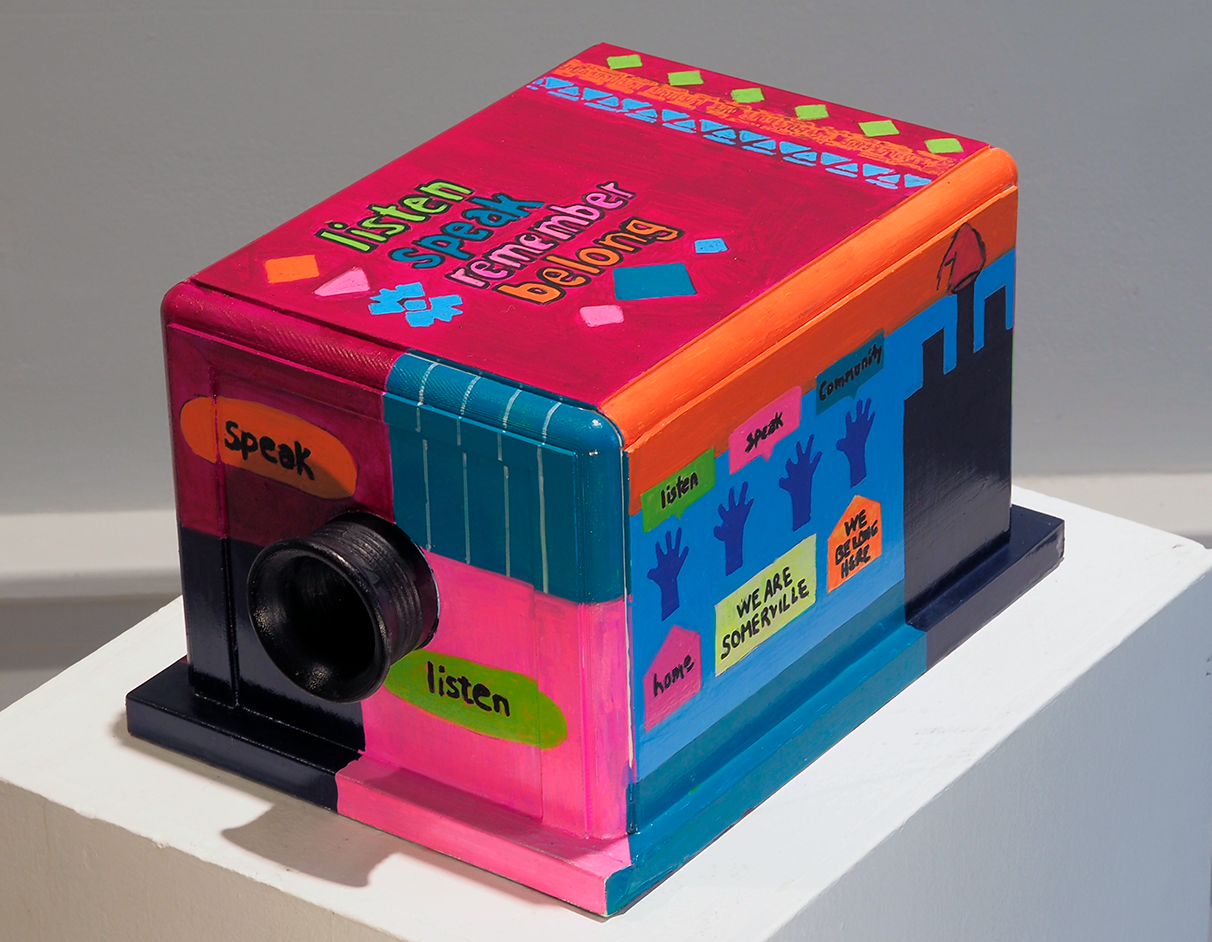
We are Somerville is a layered meditation on freedom, voice, and belonging that weaves together the history of Somerville's Union Square with the visual heritage of the Andes. The object's form as a telephone, an instrument of speaking and listening, is itself the message: "Speak" and "listen" border the receiver hole, while raised hands and speech bubbles proclaiming "WE ARE SOMERVILLE" and "WE BELONG HERE" echo the spirit of Liberty Pole Square, where residents once planted a flagpole crowned with a Phrygian cap as a declaration that freedom was worth defending. That same red capped pole appears in silhouette on the cityscape panel, grounding the piece in the specific geography of Prospect Hill. The reverse side abandons text for pure Andean textile language, with bands of hot pink, yellow green, orange, and teal carrying zigzags, step fret keys, and diamond lattices drawn from Peru's indigenous weaving traditions, a reminder that symbols of freedom and identity long predate any republic. A hummingbird, cantuta bell flowers, and marigolds frame "Union Square" on the final face, merging Somerville's civic identity with the flora of the artist's Peruvian homeland and honoring the immigrant communities whose cultures, labor, and presence are woven into the fabric of Union Square itself. The telephone ultimately insists that to listen, speak, remember, and belong are acts of freedom that every community, no matter where it came from, must keep performing together.
Historical Background
Today’s Union Square was once known as Liberty Pole Square. In 1853, Somerville’s firefighters erected a tall flagpole here, naming the spot in honor of liberty — a powerful act during a time of growing Northern resistance to slavery.
The men of Somerville Engine Company No. 1 built the pole, including James (Jimmy) Williams, an African American firefighter and one of the department’s most respected members. Upon its completion, they crowned the pole with a Phrygian cap — a soft, red cap with ancient roots as a symbol of freedom.
The Phrygian cap dates back to ancient Rome, where freed slaves wore it to signify their liberation. After Julius Caesar’s assassination, Romans hoisted a liberty pole topped with a Phrygian cap to celebrate freedom from tyranny. Centuries later, American colonists revived the symbol: towns erected liberty poles to protest British rule. Patriots at Prospect Hill (in present-day Somerville) raised a 76-foot liberty pole using a mast seized from the British ship HMS Diana. It was on this pole a year later that George Washington flew the first Grand Union Flag.
Unlike Foss Park, which became a site of protest because of its visibility and open space, Union Square has functioned for more than two centuries as a crossroads where people gather, celebrate, recruit, organize, demonstrate, debate, and perform civic identity. Its history is one of continual public assembly.
For more than two centuries, people have come to Union Square not just for restaurants and recreation, but to gather. From Revolutionary-era mobilization and Civil War recruitment to anti-slavery activism, labor organizing, political demonstrations, festivals, and public celebrations, Union Square has been a place where Somerville residents make themselves visible to one another. Here, freedom has been expressed through assembly—the right to gather, speak, protest, celebrate, and participate in public life.
Leddy Rosalia Saenz
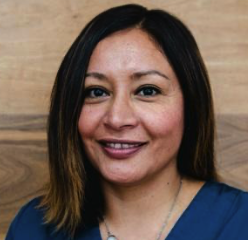
Leddy Rosalia Saenz is an interdisciplinary artist whose work explores hybrid identities, migration, and spatial justice through sculpture, painting and community-centered public art. Drawing from her Peruvian heritage, she merges practices like quipu weaving and storytelling with contemporary technologies like digital fabrication and 3D printing. Her painted 3D-printed telephone for Union Square brings these threads together: adorned with Andean textile motifs, geometric patterns, and the flora of her homeland, it asserts that Somerville's immigrant communities are not visitors to this history but part of its living fabric. The piece connects to Union Square's origins as Liberty Pole Square, where a Phrygian cap once crowned a freedom pole built by residents who believed belonging had to be claimed out loud. Saenz carries that tradition forward with the words listen, speak, remember, belong, inviting everyone who encounters the work to see themselves as participants in the ongoing story of this place.