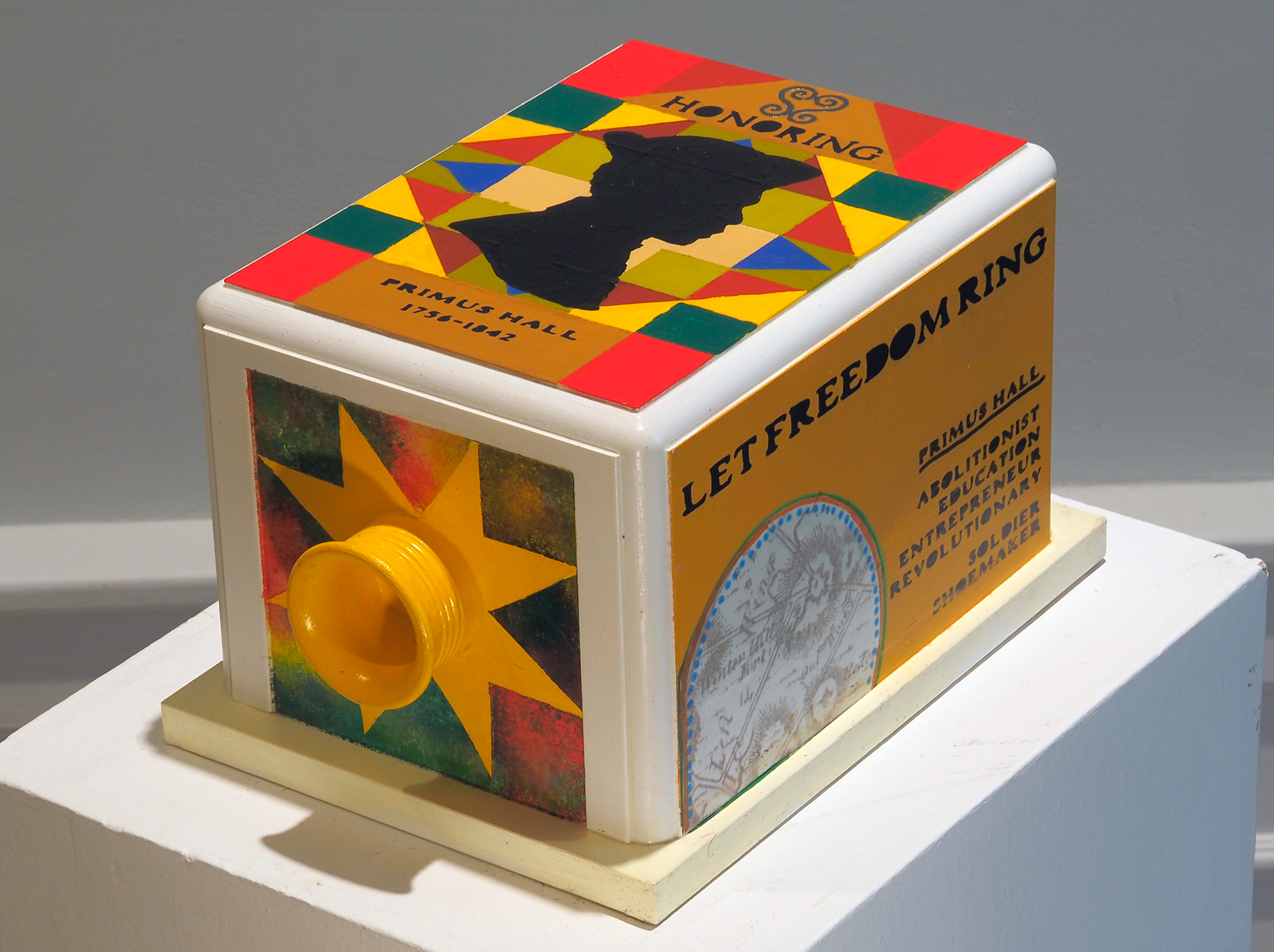
10- PRIMUS HALL
Listen!
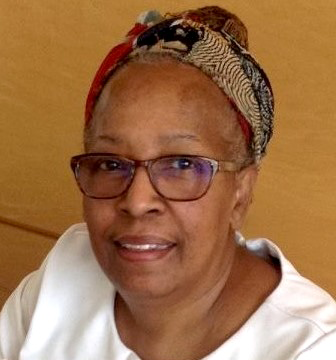
Lesyslie Rackard
Artist Statement
“Let Freedom Ring” serves as the conceptual anchor of the design, linking the lived experiences of Primus Hall and other soldiers of color at Winter Hill during the Siege of Boston (1775–1776) to the ongoing struggle for freedom and voice. Drawing on quilting traditions as a form of design, storytelling, and collective memory, the composition uses a horizontal format that allows the narrative to unfold as a continuous visual band, moving from individual identity to collective contribution and outward to the surrounding landscape. In this way, quilt-based design is reimagined as a shared public narrative form.
Historical Background
Primus Hall was a Revolutionary War soldier, an abolitionist and leader for Black education in Boston. He was born in 1756 in Boston to Delia Hall, a domestic servant, and Prince Hall, who was enslaved by William Hall until gaining his freedom in 1770 and becoming an important abolitionist leader and founder of the Black Masons in Boston. To avoid an extra mouth to feed, it was common practice to send infants of enslaved people away. Primus was sent away as an infant to live with Ezra Trask in Danvers as an indentured apprentice to learn the business of shoemaking, until he joined the Continental Army at the age of 19 during the Seige of Boston.
Black Revolutionary soldiers were fighting for the side of “freedom”, though not all interpreted that side in the same way. Some fought for the British side, since winning would mean defeat for their enslavers. Others, like Primus Hall, felt a kinship in the Patriot’s fight for freedom from British rule.
During the Siege of Boston, Primus Hall was stationed at Winter Hill, helping to guard the extensive fort until the British evacuation in March of 1776. It is possible that he was present at General Washington’s raising of the Grand Union Flag on Prospect Hill on January 1st, 1776.
As a Revolutionary soldier, he was at General Washington’s side and for the maneuvers and battles up and down the East Coast, for the crossing of the Delaware, and at Washington’s request, for the capture of General Burgoyne and surrender of Lord Cornwallis. There are even incidents recounted about Primus Hall holding a rope for Washington as he jumped over it for exercise, and Washington, while staying at his friend Colonel Pickering’s, realizing that Primus (Pickering’s steward) had given Washington his bed, offered to share the bed so Primus would have a place to sleep too.
After the war, Primus moved back to Boston and became a successful soap-maker. He began to buy real estate in Beacon Hill near where his soap workshop was located, on what is now known as Primus Avenue, off Phillips Street. Primus owned several properties, and one was on Milk Row (Somerville Ave) near Union Square, which he bequeathed to his third wife, Ann, suggesting that they might have shared that home at some point. By 1781, he had joined his father in fighting for the education of Black children and petitioned the government to establish a school for Black children. When they were unsuccessful, they raised private funds from African- American seamen and started a school in Primus’ basement in Beacon Hill, which later moved to the African Meeting House. By 1788, he had joined his father, Prince Hall in his abolitionist work and became chair of the African Society of Boston and spoke out against the persistence of slavery long after it was officially abolished in 1808. After his death in 1842, Primus Hall’s legacy of community service and fighting for freedom and justice inspired generations to come.
Lesyslie Rackard
Lesyslie Rackard has had an ongoing love of sewing for most of her life. She learned to sew while attending the Bancroft Elementary School in the South End section of Boston, MA. In those days, home economics was a mandatory part of the curriculum. First, she learned how to make a gingham checked bookbag and a white apron for the basic cooking class. Now, she has traded the savory (aprons for cooking class) for the down-home comfort of hand-made quillows (quilts with a reversible pocket sewn on the quilt so it can be folded up to fit inside the pocket), dolls, and casual wear.
Lesyslie’s crafting/sewing journey started about 25 years ago when she taught herself to quilt from library books and magazines, and then started taking classes in the Boston area. Even though she considers herself a beginner, the joy of making such lovely keepsakes is what she loves to do for her family, friends, and community.
Ms. Rackard is retired from a career as an Administrative Assistant at Tufts University in Boston. After joining the Sisters In Stitches Joined By The Cloth Quilt Guild in 2003, which provided additional guidance and support, she committed herself to the African-American quilting tradition and other local community activities. Her work has been exhibited in several venues throughout Massachusetts, New Jersey, California, Georgia, and Connecticut.