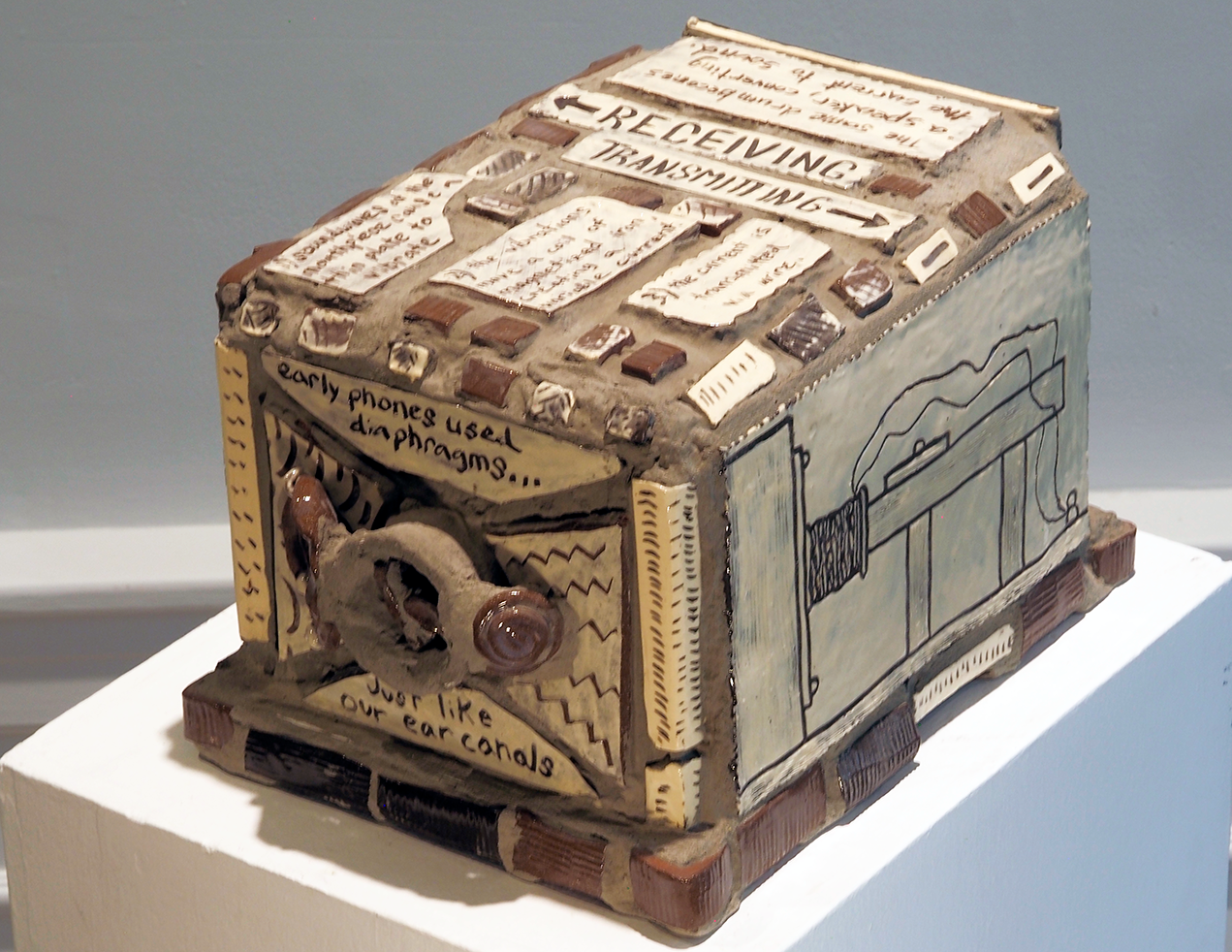
1 - One Arlington Street - Home of the World’s First Residential Phone Call
Listen!

Ruth Miller
Artist Statement
Art and technology produce a creative tension that enhance each other, and I've built a practice around interrogating that relationship. As a technologist, being an artist gives me a useful skepticism: who made this, for what purpose, and who does it actually serve? As an artist, being a technologist pushes me to ask how things work, how they could work differently, and how they might be used to extend or limit our agency? Together, these questions lead me to a conviction that we're all entitled to share: we have a right to understand how our technology works, to repair it, and to retain ownership over what it produces.
The Charles William house offered an excellent site to explore this tension. I wanted to tell the practical story of how these early devices actually worked, to ground the mechanism within our understanding. The device on display here was once revolutionary, but we've since absorbed its descendents completely into our lives. Clay seemed like the right materials to make this point. Similarly, museums around the world showcase ancient bowls and animal figures that would look just as natural in our modern kitchens and bookshelves. The cycle of forgetting and normalizing technology feel significant.
I also couldn't resist one of my favorite moves: creating a functional digital artifact with an analog material. While you scan the hand-carved QR code to learn more about this series, ask yourself: what other assumptions about how technology is supposed to look, feel, and behave should we be questioning?
Historical Background
This was the home of Charles Williams Jr. [b. 1830, d. 1908], who owned a workshop at 109 Court Street, Boston that manufactured some of the finest telegraph instruments in the country. Williams also leased workspace, equipment, and the services of his mechanics to inventors to develop prototypes of their inventions. Thomas Edison, who rented space in Williams’ shop for many years, described the instruments built there as of the “most excellent character.” One of Williams’ most promising apprentices was a young man from Salem, Mass., named Thomas Watson.
In 1874, an elocution professor named Alexander Graham Bell came to Williams’ workshop to do experimental work on a harmonic telegraph to try to transmit multiple messages simultaneously over a single telegraph line. Bell began working with Watson, and, although they never succeeded in creating a harmonic telegraph, they did develop a way to make a current of electricity vary in its intensity when a sound passed through it, thus allowing any sound, even the human voice, to be telegraphed. They called their invention the telephone. On April 4, 1877, they successfully tested their device. All early telephones were numbered in the order they were manufactured. Telephone #1 was here at Williams’ home. It was connected by a three-mile line to telephone #2 at his workshop in Boston.
Those first telephones were small wooden boxes. There was no receiver, no crank to turn, no bell to ring. To call the attention of someone at the other end of the line, you tapped on the diaphragm with a pencil. Bell had suggested that “Ahoy” be the standard phone greeting. It was Edison who popularized the use of “Hello” instead. Williams wrote, “I made all of Bell’s telephones for a long time. Almost every batch we turned out was an improvement over the preceding ones.” Williams was not only the sole manufacturer of the first telephones, but also one of the first agents authorized to lease them to customers. The first person to lease a private telephone was Frank Downer, who connected his office in Boston, with his home on Winter Hill in Somerville.
Although many saw the newly-invented telephone as a novelty or passing fad, soon recognition of its usefulness began to catch on. Less than three years after the first phone call, Williams was producing 670 phones a week, and by 1880 it was 1000 a week, which was still not enough to keep up with demand. Bell bought a controlling share of Western Electric and merged Williams’ factory into it. There Williams oversaw the production of telephones until he retired. Within a few years telephone wires were expanding
to link people around the world. Williams could not have foreseen the role telephones would come to play in history: In 1963, three days after Pres. Kennedy’s assassination, Pres. Johnson called Martin Luther King, who suggested that one of the greatest tributes they could pay to Kennedy would be to enact some of the progressive policies he had
sought to initiate. That call led to the Voting Rights Act of 1965, which prohibits racial discrimination in voting.
On July 20, 1969, Neil Armstrong onboard Apollo 11 called Mission Control from the lunar surface and said, “The Eagle has landed.” It was the first phone call from another world. Later Pres. Nixon called Apollo 11 saying, “Hello Neil and Buzz [Aldrin], I am talking to you by telephone from the Oval Room at the White House.” Three years later, President Nixon made a phone call that would eventually end his presidency, when he instructed his chief of staff to have the CIA block the FBI’s investigation into theWatergate break-in. That conversation, later revealed on tape, provided the hard evidence that forced
Nixon to resign. Today we may take our phones for granted, yet it was that very first call that took place here that revolutionized communications and connected the world.
Text written by Chris Wisniewski
Ruth Miller
Ruth Miller is a ceramicist and mixed media artist based in Somerville, Massachusetts. Her work interrogates how we interact with and understand technology, from the relationship between textiles and labor to making functional digital tools out of unconventional and analog materials. She studied transportation planning at MIT and UC Berkeley and works professionally in transit technology. She has sold ceramics at Ward Maps in Cambridge, Scritches and Boops in Somerville, and Literally Local in Brookline.