2- Cobble Hill / McLean Asylum for the Insane
Listen!
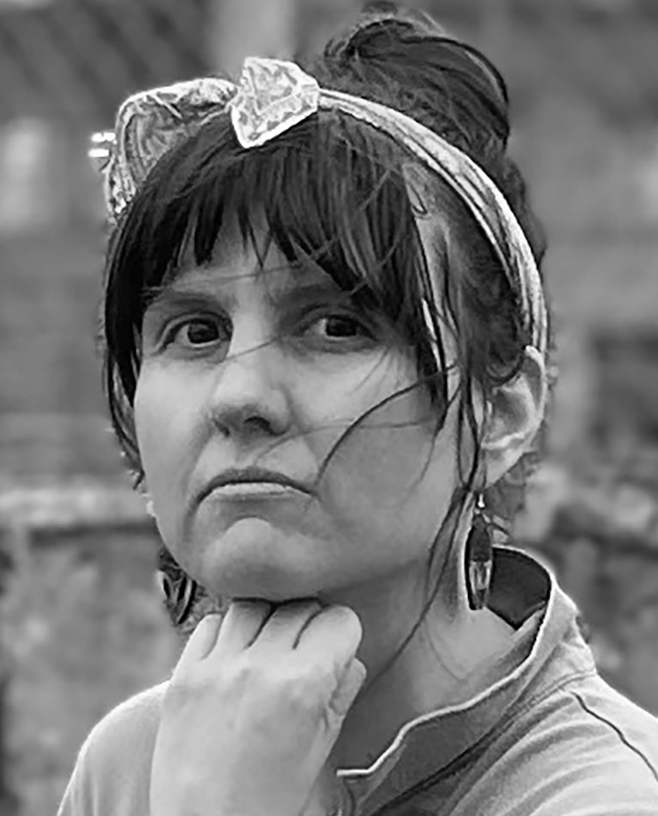
Missy Arellano
Artist Statement
“Those who have learned to listen to trees no longer want to be a tree. They do not yearn to be anything but what they are. That is home. And that is happiness.” - Herman Hesse
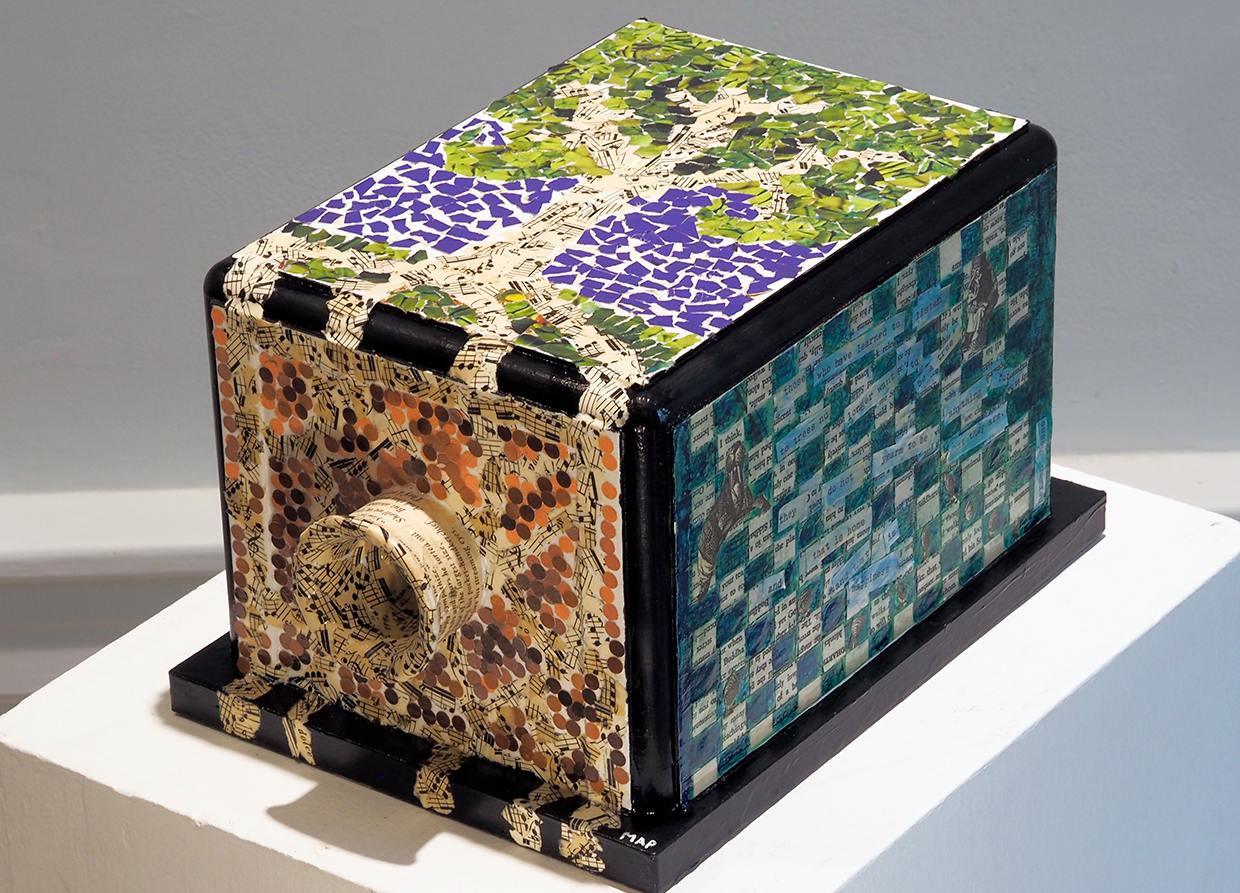
This piece, Rooted, speaks to the joy and grief of healing.
Learning to heal is a lifelong journey. The books, papers, watercolor, paint, and glue in this analog collage all tell a story woven throughout the piece. I tirelessly cut, ripped, glued, and painted to find depth and meaning through a two-dimensional collage on a three-dimensional surface in a four-dimensional world.
Through the process of layering, transfiguring, and transmuting paper, I want the viewer to reflect on the value of nature, stories, and the act of creating as a way to practice the moral cure.
I remember sitting beneath a tree in Laguna Beach, CA. It was the first thing I did after spending weeks inside a psychiatric hospital. As the weeks progressed, I continued to sit under that tree until I was brought back into the world.
Under that tree, I worked to unravel thoughts and behaviors that no longer served me. And I spent time meditating on how I came to sit under the tree.
I talked to the earth and listened to the wind.
I walked away, resolving to stay present, release the past, and have hope for the future. As the roots of a tree keep it grounded in the earth, I, too, worked to emulate that balance.
My moral cure is my creative practice in the analog. Collage, photography, and writing all have helped to develop the person I am today, a mother artist, educator, and a forever student, working in community.
The impact of music and art on my journey as a creative grounds me in ways that medicine, therapy, or my treatment plan does not. And by weaving my creative practice into my medical treatment plan, I continue to [creatively] contribute to my growth and my surroundings.
Historical Background
Joseph Barrell, a wealthy Boston fisheries and shipping merchant hired architect Charles Bulfinch, to design an estate on Cobble Hill in Charlestown, Massachusetts — now Somerville. The Barrel mansion was the first residence designed by Bulfinch. Built in the French style, its rooms faced the river with two end rooms adjoining an elliptical salon, and a signature double flying staircase. The setting was bucolic with idyllic gardens and shade trees overlooking the Charles River
In the early 19th century, with Boston lacking a hospital and the mentally ill relegated to straw beds and pails in the almshouse or left on the streets, Reverend John Bartlett, chaplain of the almshouse, appealed to Boston’s elite to establish an asylum. His call led to a petition and the 1811 founding of the Massachusetts General Hospital Corporation. After fundraising, Massachusetts General Hospital purchased the Barrell estate in 1816, and by 1818 opened the Asylum for the Insane—the first hospital in New England dedicated to mental health and only the fourth in the nation. Set in a pastoral mansion and embracing the humane principles of “moral treatment” from Europe, the asylum offered piano music, billiards, a library, and dance parties for patients—radically contrasting the austere and inhumane conditions of other asylums and prisons across Massachusetts. The therapeutic treatment included hands-on activities such as weaving, gardening, and woodworking allowing patients to draw on their own resources to break through their illness and their way back to themselves.
In June of 1826, John McLean bequeathed a substantial amount of money for the Asylum and it was renamed the McLean Asylum for the Insane. The asylum remained in Somerville until 1896, when the expansion of the Boston and Lowell Railroad cut straight through the grounds eroding its tranquil setting and forced its relocation to Belmont. The mansion was razed, but the historic trim and staircase, as well as four marble mantel side pieces, went to the home of Francis Shaw in Wayland. Upon Shaw’s death, his daughter Miriam Shaw donated it to the Somerville Museum where it has been incorporated into the Pisa Gallery.
Missy Arellano
Missy Arellano is a native Angeleno now working in Cambridge, MA. She is a community artivist whose work explores themes of motherhood, being queer and disabled, and surviving trauma across multiple disciplines. Through analog collage & photography, she plays with paper to unfold and understand her dreams, creating a living archive for her son and family. Collaging and photography are more than an art practice; they are a form of meditation and reflection, and a way to activate and amplify the stories of her ancestors.
With over two decades of experience in the arts, Missy has contributed to a wide range of creative initiatives, from facilitating and designing children’s programming in museums to managing artists at festivals, fundraising for public television, and teaching young children about contemporary art. She has exhibited work and facilitated arts workshops in California, Massachusetts, Indiana, Chicago, and Louisiana. Her current work focuses on creative placemaking and inclusivity in public spaces. She hosts collage gatherings to foster dialogue on the intersection of community, play, and creativity. Through her collage practice, she prompts participants to envision, dream, and build more inclusive and vibrant urban spaces.
Missy holds a BA in Art History and French from California State University, Long Beach (2014), an MPA from the University of Southern California (2021), and an Ed.M. from Harvard Graduate School of Education (2024).