9 - BLESSING OF THE BAY / TEN HILLS FARM
Listen!
Anna-Celestrya Carr
Artist Statement
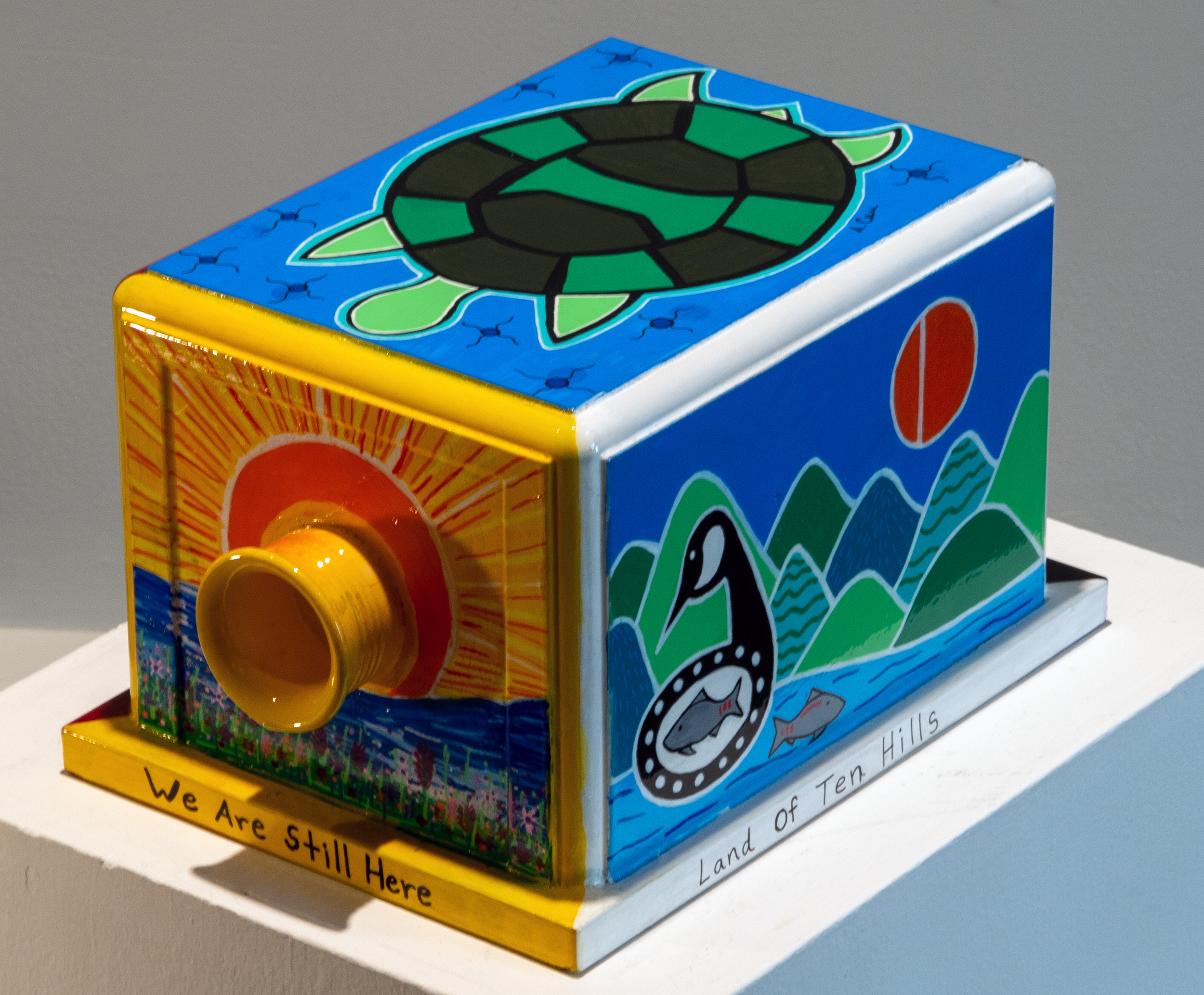
This painted phone box is inspired by the Indigenous history of the Mystic River and Ten Hills. Through symbols of Turtle Island, water, birds, and the landscape, the artwork reflects the deep connections between land, culture, and community that have existed here for
thousands of years.
As both an artist and the Historic Events Manager at the Somerville
Museum, I am interested in how stories connect people to place. My work draws inspiration from Indigenous artists such as Daphne Odjig and Jackson Beardy, whose use of color, symbolism, and storytelling
continues to influence my practice. Rather than depicting a single historical moment, this artwork invites viewers to consider the many layers of history that exist around us and to recognize that Indigenous stories are not only part of the past; they remain living, evolving, and present today. Through this piece, I hope to encourage reflection, curiosity, and a deeper connection to the land
and waters that continue to sustain us.
Historical Background
Somerville was historically embedded within Charlestown, a large tract of land home to the Naumkeag tribe and the Pawtucket band of theMassachusett tribe.
Between 1616 and 1619, disease and a series of vicious attacks by the Tarratines of Maine largely wiped out the indigenous population, including Nanepashemet (“New Moon”), the chief of the Pawtucket, leaving his widow, Saunskwa of Mystik in the leadership role. A very reduced indigenous population was left by the time the Plymouth Council granted the land to the Massachusetts Bay Company in 1628.
Under increasing encroachment by the colonists, and with so many of her people, including two of her own sons lost to battles and smallpox, on April 15, 1639, Saunskwa of Mystik (“Chief of Mystik” who never wanted to be known by her real name) and her second husband Webcowit, deeded Charlestown to the English settlers. In exchange, Saunskwa of Mystik was able to retain a tract of land (until her passing), and received "twenty and one coats, 19 fathoms of wampum, and three bushels of corne." Wampum were shell beads used as currency among the Northeastern indigenous tribes.
John Winthrop, Massachusetts First Governor, was one of the early colonists who settled in Ten Hills in 1630 and his estate became known as Ten Hills Farm. After Winthrop’s arrival, he immediately set his sights on building the first ocean-going, trading vessel in New England and second in the country only to the Virginia in 1607. Winthrop named his ship, “Blessing of the Bay”, and first launched it on July 4th, 1631. It was used for trade around New England and with the Dutch in New York. It was thought to be lost at sea on a trip to Virginia in 1633. Governor Winthrop was known for building a “city on a hill” as a model Christian society and for ratifying the 1641 Body of Liberties, written by Nathanial Ward. While the Body of Liberties is considered the first bill of rights, it was also the document that codified slavery in the North. Section 91,
stated that:
There shall never be any bond slavery, villenage or
captivity amongst us except for lawful captives taken
in just wars or those who willingly sell themselves or
are sold to us.
In the aftermath of the Pequot War (1636-1638), Winthrop notably enslaved
Wincombone (a significant leader known for her diplomacy, as well as the wife of Pequot Sachem) and her children, Many other indigenous people were enslaved during the Pequot War and King Philip’s War (1675-1676) and traded all throughout the Caribbean in exchange for goods and enslaved Africans, the first of whom arrived in Boston in 1638. Ten Hills Farm was intimately tied to the North’s legacy of slavery, beginning with the Winthrop’s and continuing through subsequent owners, most notably the Ushers and the Royals, all who owned and traded enslaved Indigenous and African people.
Each year, the Somerville Museum holds a participatory family event on this site. “Blessing of the Bay: Three Voices, One Shore” addresses this history through song, dance and storytelling.
Anna-Celestrya Carr
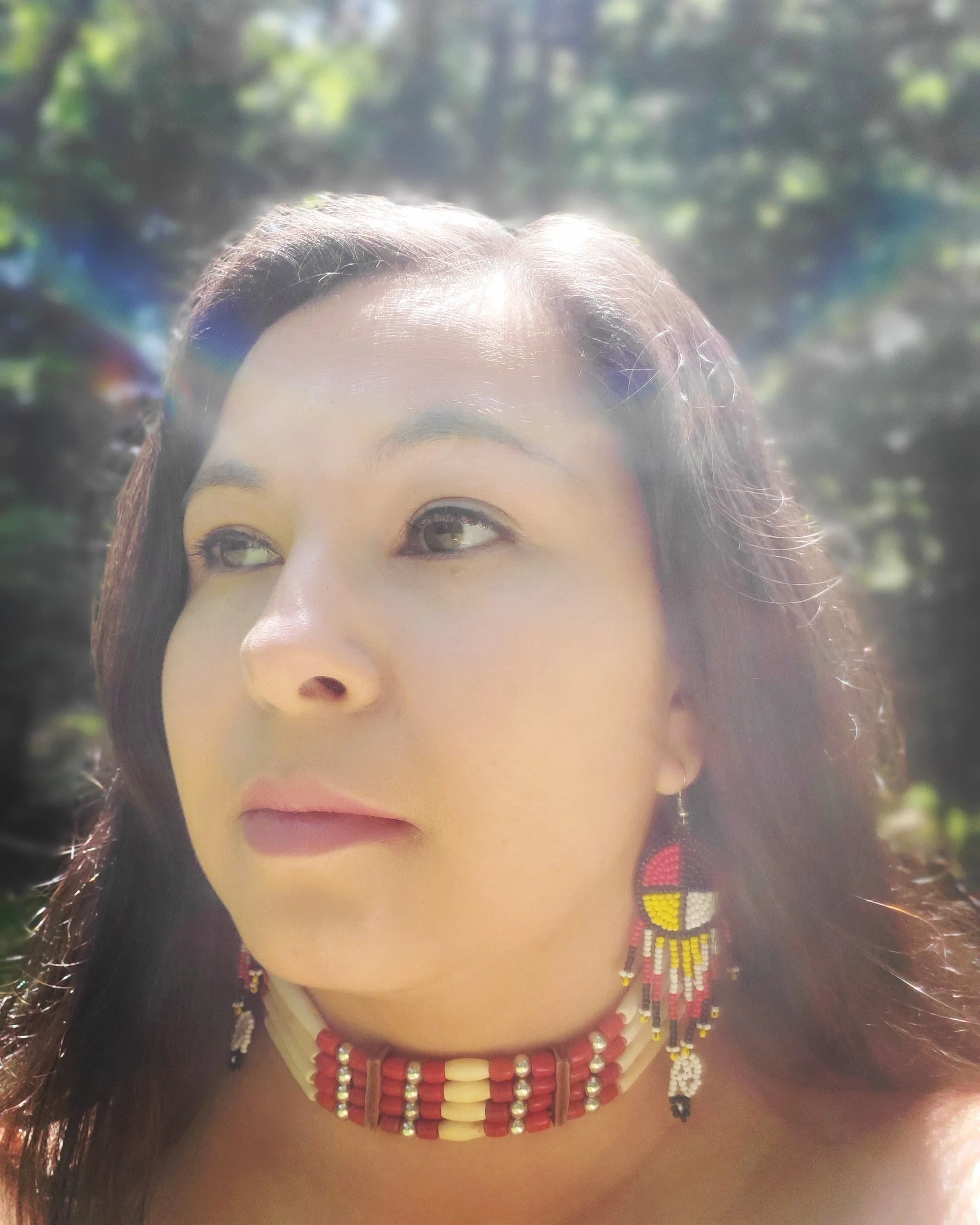
Anna-Celestrya Carr is a Métis/Oji-Cree multidisciplinary artist, award-winning filmmaker, writer, dancer, activist, and cultural educator originally from Manitoba and now based in Massachusetts. She currently serves as the Historic Events Manager at the Somerville Museum, where she develops programs that connect people to local history through storytelling, community engagement, and public events.
Carr is the recipient of two human rights awards for her advocacy and community work. Through painting, film, performance, and public art, she explores themes of Indigenous history, identity, resilience, and relationships to land and water. Inspired by the work of Daphne Odjig and Jackson Beardy, her artwork uses bold colors, strong lines, and symbolic imagery to share stories that bridge past and present. Her work invites viewers to reflect on history, community, and our connections to one another and the natural world.